Learn / Homeowners insurance (Tennessee)
Do I Need Earthquake Insurance in Tennessee? What It Costs, How the Deductible Works, and the Brick Problem
Updated 2026-09-15 · reviewed by a licensed agent
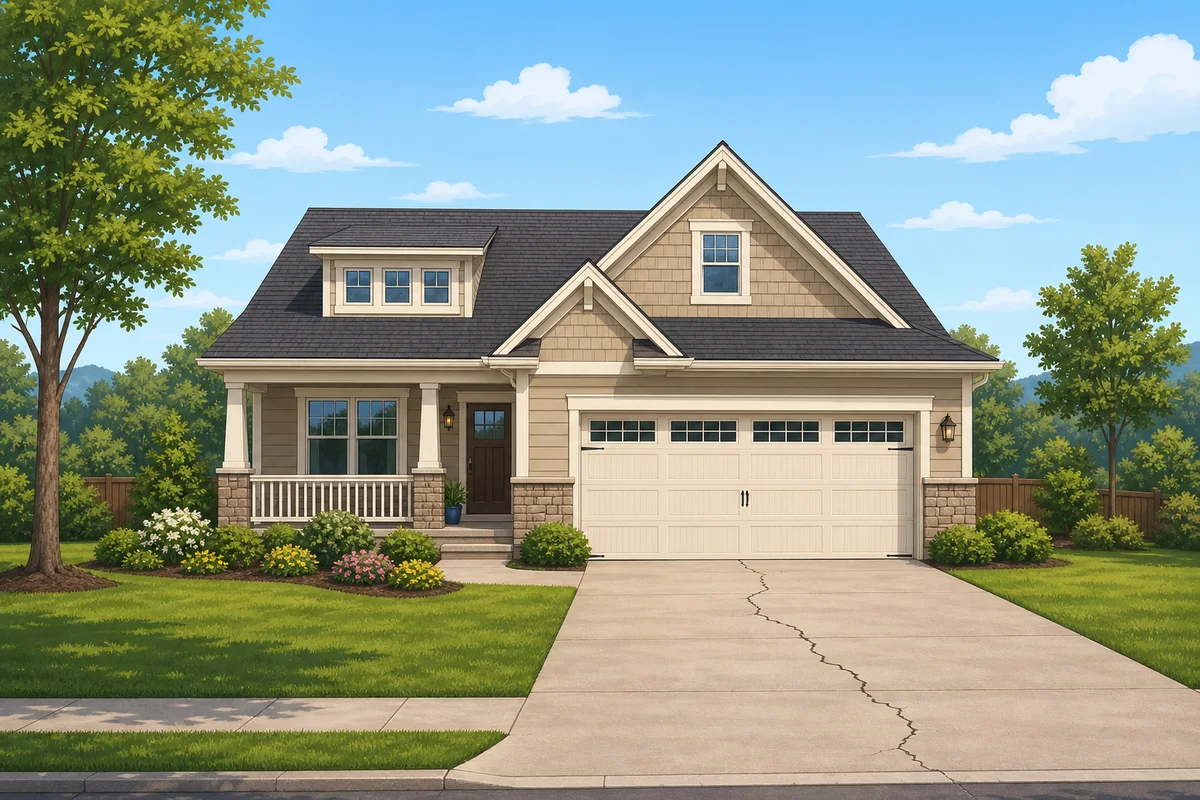
No, your Tennessee homeowners policy does not cover earthquakes — and yes, for a lot of Tennessee homes the coverage is worth having, because it's cheap relative to the loss it protects against. Earthquake coverage is a separate endorsement or standalone policy that typically runs a few hundred dollars a year, carries a percentage deductible of 5%–20% of your dwelling coverage, and on many policies quietly excludes the brick veneer on your house. Here's the math, the brick problem, and why timing matters more than most people think.
Does my homeowners insurance cover earthquakes in Tennessee?
No. Every standard homeowners policy — captive or independent, cheap or premium — excludes "earth movement." That one exclusion covers earthquakes, sinkholes, landslides, and mudflow. An earthquake that cracks your foundation, drops the brick off a gable, or collapses a chimney is on you unless you've specifically added earthquake coverage.
Tennessee homeowners get surprised by this twice. State law requires carriers to offer sinkhole coverage, so most people have at least seen that line on a quote. There's no equivalent requirement for earthquake coverage. Nobody has to mention it, and in our experience most Tennessee homeowners have never actually been offered the choice.
Is Tennessee really at risk for earthquakes?
Yes — Tennessee sits on two active seismic zones, and both have moved in the last 18 months.
| Zone | Where | What the science says |
|---|---|---|
| New Madrid Seismic Zone | West Tennessee — Memphis, Jackson, the Mississippi River counties | USGS: 25%–40% chance of a magnitude 6.0+ quake in the next 50 years, and a 7%–10% chance of a repeat of the 1811–1812 quakes (magnitude 7–8, three of them over a winter). A magnitude 4.0 near Cooter, Missouri on April 23, 2026 — about 80 miles north of Memphis — was felt across West Tennessee and into Middle Tennessee (Clarksville, Chapel Hill). It was the first magnitude-4 New Madrid event since 2005. |
| East Tennessee Seismic Zone | Chattanooga → Knoxville → the Tri-Cities, following the Valley and Ridge | One of the most active seismic zones in the eastern U.S. A magnitude 4.1 near Greenback (Loudon County) on May 10, 2025 was felt from Knoxville to Atlanta, generating over 45,000 "Did You Feel It?" reports. A magnitude 4.4 near Decatur in December 2018 was felt across the Southeast, including Atlanta. |
Two things about eastern earthquakes make the risk bigger than the magnitude numbers suggest. First, quakes east of the Rockies are felt over a far larger area than western quakes of the same size, because the old, cold crust transmits shaking efficiently. Second, almost nothing in Tennessee was built to a seismic code — the brick-veneer-on-frame house that dominates every subdivision from Germantown to Farragut is close to the worst-case wall type for shaking.
Middle Tennessee is the low-risk part of the state, but "low" isn't "zero": the 2026 Cooter quake was felt in Williamson and Marshall counties, and Nashville-area homes sit between both zones.
What does earthquake insurance actually cost in Tennessee?
For most Tennessee homes, a few hundred dollars a year — often somewhere around $100 to $400. Price moves with four things: your dwelling limit, your distance from the New Madrid zone (Shelby County pays more than Rutherford County), your construction (brick veneer costs more to cover than frame, when it's covered at all), and the deductible you pick.
Compare that with Missouri's Bootheel, the other side of the same fault. There, earthquake premiums rose roughly 334% between 2000 and 2018, and the share of homes carrying the coverage in the seven-county New Madrid region fell from over 60% in 2000 to 10.4% in 2024 — the Missouri Department of Commerce & Insurance calls it a market on the verge of collapse. Tennessee pricing hasn't repriced that way yet. That's not a promise it won't; it's a reason the coverage is worth looking at while it's still inexpensive here.
How does the earthquake deductible work?
It's a percentage of your dwelling coverage (Coverage A) — not a percentage of the claim. That's the same mechanic as a percentage wind/hail deductible, only bigger. The Tennessee Department of Commerce & Insurance says 10%–20% is typical; some standalone policies offer 5% (usually with brick veneer excluded) and some go to 25%.
| Dwelling coverage (Coverage A) | 5% deductible | 10% deductible | 15% deductible | 20% deductible |
|---|---|---|---|---|
| $300,000 | $15,000 | $30,000 | $45,000 | $60,000 |
| $400,000 | $20,000 | $40,000 | $60,000 | $80,000 |
| $600,000 | $30,000 | $60,000 | $90,000 | $120,000 |
| $800,000 | $40,000 | $80,000 | $120,000 | $160,000 |
| $1,000,000 | $50,000 | $100,000 | $150,000 | $200,000 |
Three details that don't show up on a one-line quote:
- Contents and other structures often carry their own separate deductibles, so a quake that damages the house, the detached garage, and everything inside can trigger three deductibles, not one. Read the endorsement.
- Your Coverage A rises every year with inflation-guard, so your earthquake deductible in dollars quietly rises with it — the same drift that pushes premiums up at renewal.
- The deductible tells you what the coverage is for. It will not pay for a hairline crack in the driveway or a few drywall seams. It exists for the event that makes a $400,000 house uninhabitable — where a $40,000 deductible stands between you and a $360,000 rebuild you'd otherwise fund yourself while still paying the mortgage.
Does earthquake insurance cover a brick house?
Not automatically — and in Tennessee this is the question that matters most. Most homes here are wood-frame with a brick veneer skin. Many earthquake endorsements and standalone forms exclude exterior masonry veneer entirely, or deduct its value from the loss before applying the percentage deductible. Brick veneer is precisely what cracks, separates, and falls in an earthquake, so a policy that excludes it can leave you covered for the framing and uncovered for the most visible damage.
| Policy type | Brick veneer | Typical trade-off |
|---|---|---|
| Endorsement with veneer excluded | Not covered; value may be subtracted before the deductible | Lower premium, sometimes a lower (5%) deductible |
| Endorsement with veneer included (the box is checked) | Covered as part of the dwelling | Higher premium and/or a 10%+ deductible |
| Standalone earthquake policy | Varies by carrier — ask | Often more flexible limits and deductible choices |
If your house is brick, ask exactly one question before you compare prices: "Is exterior masonry veneer covered, and at what deductible?" Two quotes that look $80 apart can be covering completely different houses.
Other common exclusions worth knowing: land and landscaping, swimming pools and retaining walls (sometimes), flood or water damage that follows a quake (that's flood insurance), and pre-existing cracks or settling. Loss of use — somewhere to live while the home is repaired — is usually included and is one of the most valuable parts of the coverage.
Can I wait and buy it after a quake?
No — this is the part nobody tells you. After a felt earthquake, carriers routinely impose a binding moratorium on new or increased earthquake coverage across the affected region, commonly for 30 to 60 days, until aftershock risk settles. Some policies also carry a waiting period before coverage starts. Earthquakes cluster — aftershocks and follow-on events are most likely in the weeks after the first one — which is exactly when you can't buy in.
The practical rule: you buy earthquake coverage in a quiet year. If you called an agent the morning after the 2025 Greenback quake or the 2026 Cooter quake, there's a good chance you were told to call back in a month or two.
So is it worth it for my home?
For a lot of Tennessee homeowners, yes — and for some, honestly, no. It comes down to a simple comparison: a few hundred dollars a year against the chance you'd have to fund a six-figure rebuild out of pocket.
It's most worth carrying if:
- You're in West Tennessee, anywhere in the Memphis–Jackson–Dyersburg corridor, where the New Madrid probability numbers actually apply to your ZIP code.
- You're in the East Tennessee Seismic Zone — the Chattanooga-to-Knoxville-to-Tri-Cities corridor — where small-to-moderate quakes happen every year.
- Your home is your largest asset and you couldn't self-fund a rebuild while still paying the mortgage. (Your mortgage doesn't go away because the house did.)
- You own a high-value or recently appreciated home, where the dollar loss is large and the premium is still small relative to it — crossing $1M changes several things, and this is one to check.
- Your house is brick veneer and you can get a policy that covers it.
It's a harder case if you're in Middle Tennessee in a newer frame home with a modest limit and enough liquidity to absorb a bad year — the deductible would eat most realistic losses. That's a legitimate answer; the only bad answer is never having been shown the number.
What about Georgia?
The East Tennessee Seismic Zone runs into northwest Georgia, and the 2025 Greenback quake was felt across metro Atlanta. Georgia homeowners policies exclude earth movement the same way, earthquake endorsements and standalone policies are available the same way, and the brick-veneer question applies just the same.
See what earthquake coverage would cost for your home
The number is different for every house — a brick home in Germantown, a frame home in Franklin, and a cabin outside Maryville price nothing alike, and two quotes can be covering two different definitions of "the house." That's a matching question, not a one-size answer.
Start a quote with Lumenbo and we'll match you with one licensed local independent agent who will review your complete home policy for gaps, price earthquake coverage across every carrier they represent — endorsement and standalone — with brick veneer covered, and show you the real deductible in dollars. Starting online is the fastest path to real rates. If your carrier already told you "we don't offer that," that's exactly the situation this is built for.
What is Lumenbo? Lumenbo is an insurance matching platform that connects people with one licensed local independent agency — and the software those agencies run on. Lumenbo is not an insurance carrier and not an insurance agency. Your Lumenbo-matched agent is a licensed agent at that partner agency, and they stay your point of contact.
Frequently asked
Does homeowners insurance cover earthquakes in Tennessee?
No. Standard homeowners policies exclude earth movement — earthquakes, sinkholes, and landslides — regardless of the carrier. Earthquake coverage has to be added as an endorsement to your home policy or bought as a separate standalone earthquake policy. Tennessee law requires carriers to offer sinkhole coverage, but there is no equivalent requirement for earthquake coverage, so nobody has to bring it up unless you ask.
Is Tennessee really at risk for earthquakes?
Yes. Tennessee sits on two seismic zones: the New Madrid Seismic Zone in the west, near Memphis, and the East Tennessee Seismic Zone, which runs from Chattanooga past Knoxville and is one of the most active zones in the eastern U.S. The USGS puts the chance of a magnitude 6.0 or greater New Madrid earthquake in the next 50 years at 25%–40%, and a repeat of the 1811–1812 quakes at 7%–10%. A magnitude 4.1 near Greenback in May 2025 was felt from Knoxville to Atlanta, and a magnitude 4.0 on the Missouri line in April 2026 was felt across West and Middle Tennessee.
How much does earthquake insurance cost in Tennessee?
For most Tennessee homes it's a few hundred dollars a year — often in the range of about $100 to $400 depending on the home's value, construction, and how close it is to the New Madrid zone. Brick homes and homes in West Tennessee sit at the top of the range; frame homes in Middle and East Tennessee at the bottom. It is one of the cheaper coverages you can add to a Tennessee home policy relative to the size of the loss it addresses.
How does the earthquake deductible work?
It's a percentage of your dwelling coverage (Coverage A), not of the claim — typically 5%, 10%, 15%, or 20%, and the Tennessee Department of Commerce & Insurance says 10%–20% is most common. On a $400,000 dwelling limit, a 10% deductible is $40,000. Contents and other structures often carry their own separate percentage deductibles. So earthquake coverage is catastrophe protection: it is built to pay for a home that is badly damaged or destroyed, not for a few new cracks in the drywall.
Does earthquake insurance cover brick homes?
Only if the policy says so. Many earthquake endorsements and standalone policies exclude exterior masonry veneer — the brick skin on a wood-frame house, which is exactly how most Tennessee homes are built and exactly what cracks and falls in a quake. Some carriers cover brick veneer at a higher deductible or premium; some exclude it outright and deduct its value before applying the deductible. If your house is brick, this is the first question to ask about any earthquake quote.
Can I buy earthquake insurance right after an earthquake?
Usually not right away. After a felt earthquake, carriers commonly put a binding moratorium on new earthquake coverage in the affected region — often for 30 to 60 days — until aftershock risk settles. Some policies also carry a waiting period before coverage starts. In practice you buy earthquake insurance before the ground moves, or you wait.
My carrier doesn't offer earthquake coverage in Tennessee. Am I out of options?
No. Some carriers add earthquake coverage by endorsement, some don't write it at all in Tennessee, and there are standalone earthquake policies that sit alongside any homeowners policy. A decline from your carrier is a statement about their appetite, not about your home. A licensed independent agent can source the standalone market for you.
Ready to get matched? One licensed local agent. No shared leads, no spam.
Start your quote
This article is general information for education, not insurance advice or a quote. Coverage, availability, and rules vary by insurer and by state.