Learn / Rental & short-term rental (Tennessee)
Smoky Mountain Cabin Rental Insurance: What Gatlinburg, Pigeon Forge & Sevierville Owners Actually Need
Updated 2026-08-11 · reviewed by a licensed agent
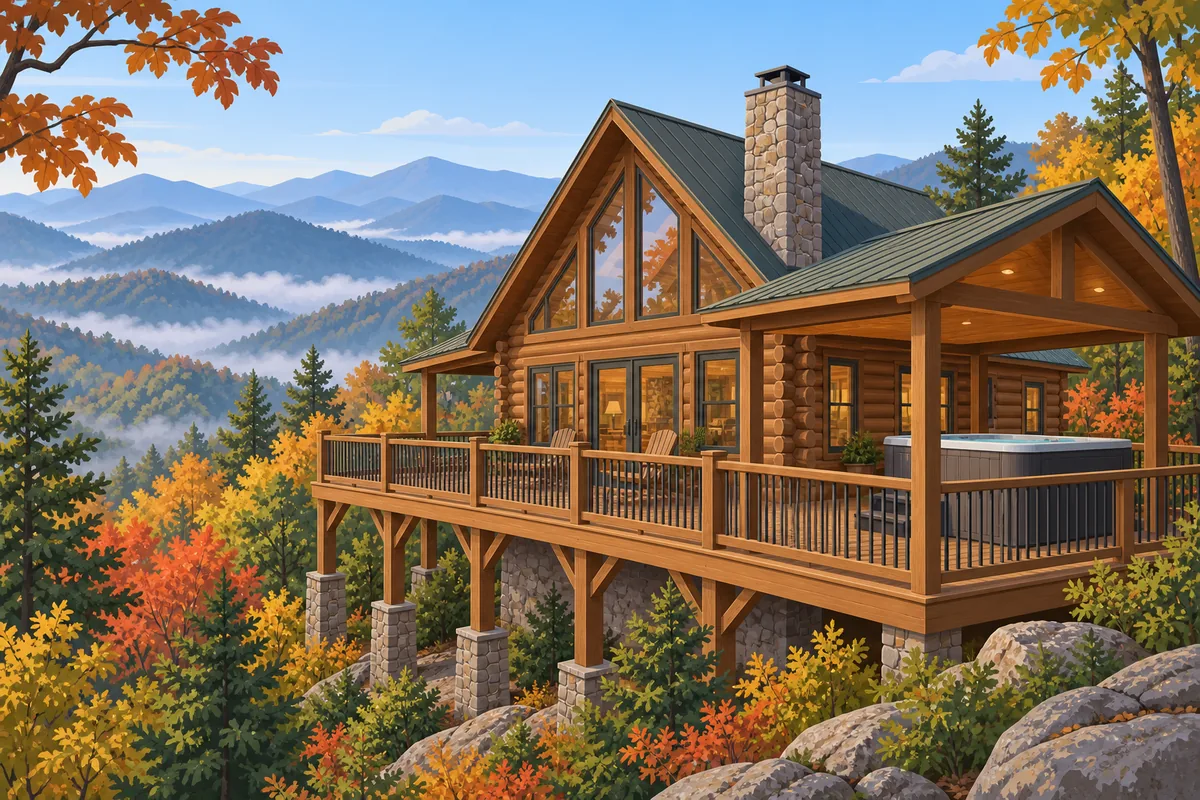
A Smokies cabin is a commercial lodging risk sitting on a mountainside, and it needs a short-term rental policy written for the property — not a homeowners policy, and not the landlord policy that works fine on a long-term rental in Knoxville. Sevier County's cabin economy is one of the densest short-term rental markets in the country, and the four things that decide your premium and your claims here — wildfire exposure, amenities, freeze losses, and peak-season income — barely come up in a Nashville short-term rental conversation.
If you're earlier in the process and still figuring out what short-term rental coverage is at all, start with the pillar: Airbnb and VRBO host insurance in Tennessee. If the cabin is a second home you sometimes use yourself, the homeowners business-exclusion trap is the piece to read first.
Why doesn't a normal rental policy work on a cabin?
Because three different assumptions break at once.
A homeowners policy assumes you live there. You don't, and paying guests trigger the business-pursuits exclusion regardless.
A landlord or dwelling-fire policy assumes a tenant with a lease — one household, screened, in place for months, with their own renters insurance. A cabin turns over every two or three nights to strangers who have never seen the deck stairs before. The differences between those policy types are worth understanding on their own, because owners buy the wrong one constantly — usually because it quoted cheaper.
And platform protection — AirCover and its equivalents — is a platform guarantee, not regulated insurance, and it does nothing for direct bookings, which is where a growing share of Smokies nights come from.
| What you're insuring | What it needs to include |
|---|---|
| The building | Replacement cost, with enough limit for mountain rebuild costs — access, slope and hauling make Sevier County construction more expensive than the same square footage in Knoxville |
| Guests getting hurt | Liability, commonly $1,000,000 per occurrence, written to contemplate transient guests and amenities |
| Furnishings and contents | Guest-caused damage to furniture, appliances, hot tub, linens, game room equipment |
| Your income | Loss of rental income / business income, with a period of restoration long enough to actually rebuild |
| The management gap | Confirmation in writing of what your management company's policy does and does not do for you |
What does wildfire risk do to a Smokies cabin policy?
This is the Sevier County–specific fact, and it's the one most owners find out about at renewal.
On November 23, 2016, a fire started in Great Smoky Mountains National Park. Five days later, winds topping 90 mph carried embers into Gatlinburg. The Chimney Tops 2 fire killed 14 people, injured 191, forced 14,000 to evacuate, burned more than 17,000 acres, and destroyed or damaged roughly 2,500 structures. Damage estimates reached about $2 billion.
Fire is a covered peril on essentially any property policy, so this isn't a coverage question. It's an appetite question. Since 2016, carriers writing in the Smokies score things they used to ignore: how steep the lot is, how much cleared space sits between the cabin and the tree line, distance to a hydrant and to a staffed fire station, roof and deck materials, and whether the only way in is a single narrow switchback road. Two cabins a quarter-mile apart can get very different answers.
What that means practically: a decline from one carrier is not a verdict on your cabin. It usually means you asked a standard homeowners market to underwrite a mountain lodging risk. The specialty short-term rental market prices this exposure as a matter of routine.
Defensible-space work — clearing vegetation back from the structure, non-combustible decking, ember-resistant vents, keeping the gutters clear of needles — is the rare mitigation that improves both your rate and your odds.
Which amenities change the underwriting?
Everything guests came for.
- Hot tubs — the most-asked question in this market. Expect a locking cover requirement, posted rules and occupancy limits, and documented sanitation. Not a dealbreaker; not something to leave off the application either.
- Pools — bigger liability step, often with fencing or gate requirements.
- Multi-level decks and stair towers — cabins built into a slope stack decks three stories up. Railing height, spacing and condition are real underwriting items, and deck falls are a meaningful share of guest-injury claims.
- Game rooms, arcade equipment, theater rooms — mostly a contents and replacement-cost question.
- Fire pits, grills, outdoor fireplaces — scored differently here than anywhere else in the state, for obvious reasons.
- ATVs, golf carts, shuttle vehicles — these are auto exposures, not property exposures, and a property policy will not respond. They need to be handled separately.
- Steep or gravel driveways — a guest sedan sliding on ice is a liability claim.
The rule is simple: if it's in your listing photos, it belongs on your application. An amenity the carrier didn't know about is the cleanest reason they'll ever have to contest a claim.
Why is loss of rental income the coverage that actually matters?
Because a Smokies cabin's year isn't evenly distributed. Leaf season in October, summer, Thanksgiving through New Year, spring break — a large share of annual revenue lands in a handful of high-rate weeks.
So run the scenario properly. A covered water loss in mid-September doesn't cost you the repair bill. It costs you the repair bill plus October. If your loss-of-income limit was set from an annual average, it will not come close.
Two things to check on the quote, and almost nobody does:
- The limit — is it built from your actual peak-season rates, or from a flat monthly average?
- The period of restoration — how long will it pay? In a market where a contractor may be booked out months and materials have to come up the mountain, a short restoration period is where the money runs out before the cabin reopens.
What about permits, and does the city care about my insurance?
Yes, and the paperwork has to agree with itself.
Inside Gatlinburg city limits, short-term rentals need a Tourist Residency Permit, and the application requires proof of insurance, a designated 24/7 local contact, a parking plan, and a life-safety self-certification (smoke and CO alarms, extinguisher, posted occupancy). Pigeon Forge and Sevierville operate their own permit programs, and unincorporated Sevier County runs a separate permit-and-inspection process. Fees and requirements have changed repeatedly in recent years — treat any number you read online, including here, as a starting point and confirm it with the city or county.
The insurance angle people miss: when the city has your certificate on file, your policy has become a public description of how the property is used. If the certificate describes a dwelling with long-term tenants while your permit says nightly lodging, that mismatch is a problem in both directions — at the permit office and at the claim desk.
The winter claim nobody budgets for
Frozen pipes. A cabin with no Monday-to-Thursday booking in January is, in insurance terms, an unoccupied building. A supply line that fails Tuesday morning can run until the Friday check-in finds it.
Most policies condition freeze coverage on either maintaining heat or shutting off and draining the water supply, and some add a vacancy provision that narrows coverage after a set number of consecutive vacant days. Read that clause before winter, not after. A low-temperature alarm and an automatic water shutoff cost a fraction of one night's peak rate and address the most expensive non-weather claim in this market.
Get it underwritten as what it is
A Smokies cabin is a small lodging business with a mountain fire exposure, a hot tub, and revenue concentrated in six weeks of the year. Insured as that, it's a very writable risk. Insured as a house, it's a claim waiting to be argued about.
Start a quote with Lumenbo and we'll match you with one licensed local independent agency whose agent places Tennessee short-term rental and cabin coverage — they can tell you which markets have appetite for your specific lot and how your loss-of-income limit should be built. More straight answers in the Learning Library.
Informational only — not a quote or a coverage determination. Policy terms, carrier appetite and local permit rules vary and change.
What is Lumenbo? Lumenbo is an insurance matching platform that connects people with one licensed local independent agency — and the software those agencies run on. Lumenbo is not an insurance carrier and not an insurance agency. Your Lumenbo-matched agent is a licensed agent at that partner agency, and they stay your point of contact.
Frequently asked
What insurance do I need for a Smoky Mountain rental cabin?
A short-term rental policy written for the property itself — dwelling on a replacement-cost basis, guest liability (commonly $1,000,000 per occurrence), contents and furnishings, and loss of rental income. A homeowners policy is the wrong instrument for a cabin you don't live in, and a standard landlord or dwelling-fire policy assumes long-term tenants rather than nightly turnover.
Does my rental management company's insurance cover my cabin?
No. Management companies carry their own liability coverage protecting the management company. You are not the named insured on it, and it does nothing for your building, your furnishings, or your lost income. Ask for a certificate showing what they carry — then insure your own property separately.
Is wildfire covered on a Smokies cabin policy?
Fire, including wildfire, is a covered peril on essentially every standard property policy — the issue in Sevier County isn't coverage, it's appetite. After the 2016 Chimney Tops 2 fire, which killed 14 people and destroyed or damaged about 2,500 structures, carriers began scoring slope, vegetation clearance, distance to a fire hydrant or station, and whether a cabin sits on a single-access road. Some standard markets decline outright; specialty markets write the same cabin without blinking.
Do I need a permit to rent my cabin in Gatlinburg?
Yes, inside Gatlinburg city limits you need a Tourist Residency Permit, and the application requires proof of insurance, a 24/7 local contact, a parking plan, and a life-safety self-certification. Pigeon Forge and Sevierville run their own programs, and unincorporated Sevier County has a separate permit-and-inspection process. Fees and requirements change — verify with the city or county before you rely on any figure.
Are hot tubs a problem for cabin insurance?
They're the single most-asked underwriting question in the Smokies. A hot tub doesn't make a cabin uninsurable, but it changes the liability rate and usually triggers requirements — a locking cover, posted rules and occupancy limits, documented sanitation, and sometimes a fence or gate. Pools, game rooms, fire pits, ATVs and multi-level decks all get scored the same way. Never leave an amenity off the application.
What's the most common cabin claim that isn't weather?
Frozen pipes. A cabin with no booking Monday through Thursday in January is an unoccupied building, and a water loss that starts on a Tuesday can run until Friday check-in. Most policies condition freeze coverage on maintaining heat or shutting off and draining the water supply — and some add a vacancy provision. Freeze sensors and low-temp alarms are cheap; the claim they prevent is not.
Ready to get matched? One licensed local agent. No shared leads, no spam.
Start your quote
This article is general information for education, not insurance advice or a quote. Coverage, availability, and rules vary by insurer and by state.