Learn / Homeowners insurance (Tennessee)
Does Homeowners Insurance Cover Frozen Pipes in Tennessee? (Yes — Unless You Trip One of These Three Conditions)
Updated 2026-11-10 · reviewed by a licensed agent
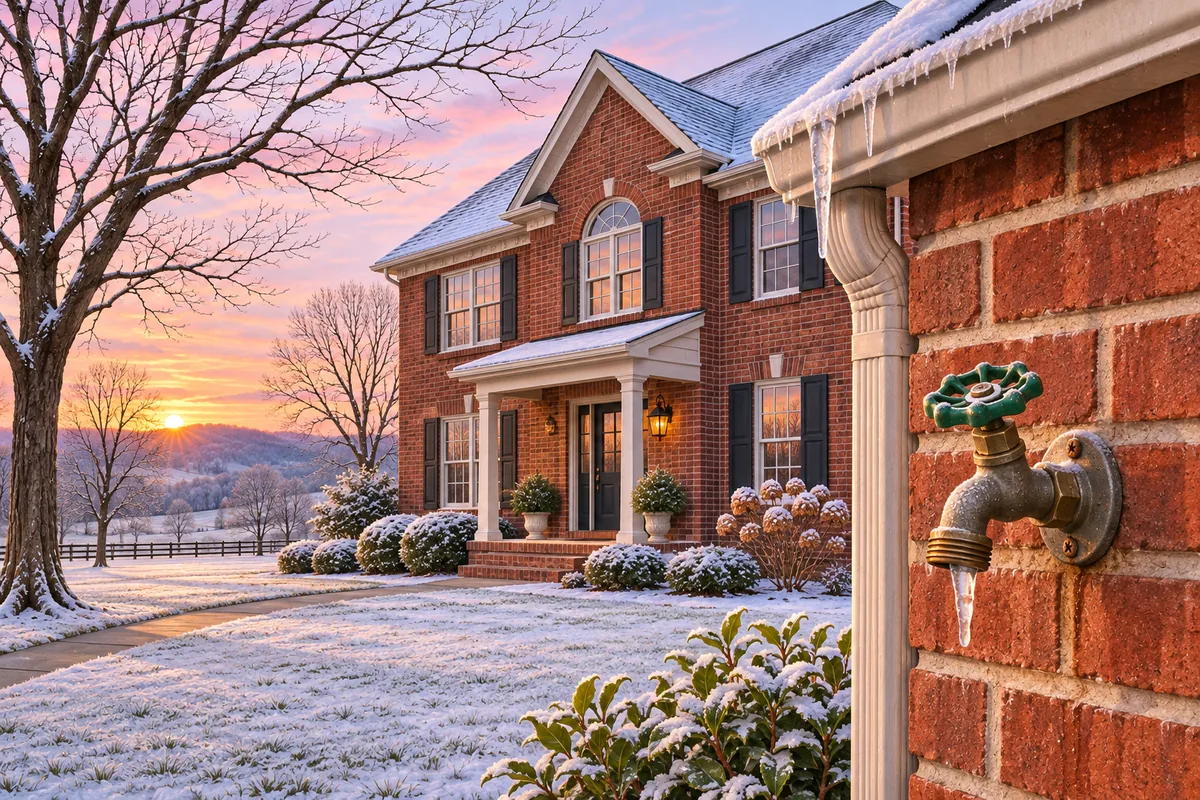
Yes — in nearly every standard homeowners policy sold in Tennessee or Georgia, water damage from a frozen pipe that bursts is a covered, sudden-and-accidental loss. The carrier pays to dry the house, replace the drywall, flooring and cabinets the water ruined, tear out whatever has to be opened to reach the break, and put you in a hotel if the house is unlivable. It is one of the most-paid home claims in both states, and it comes off your ordinary flat deductible, not the big percentage one. What gets a freeze claim denied is almost never the freeze. It is one of three conditions buried in the policy: whether you kept heat on (or drained the house), whether the house was unoccupied, and whether the leak was sudden or had been running for weeks.
This article covers the standard policy language, the parts that are different for landlords and cabin owners, and what to do in the first hour. For how the rest of your Tennessee policy handles weather, start with storm damage and roof claims and why your premium went up.
Why do Tennessee and Georgia pipes burst so much more than Minnesota's?
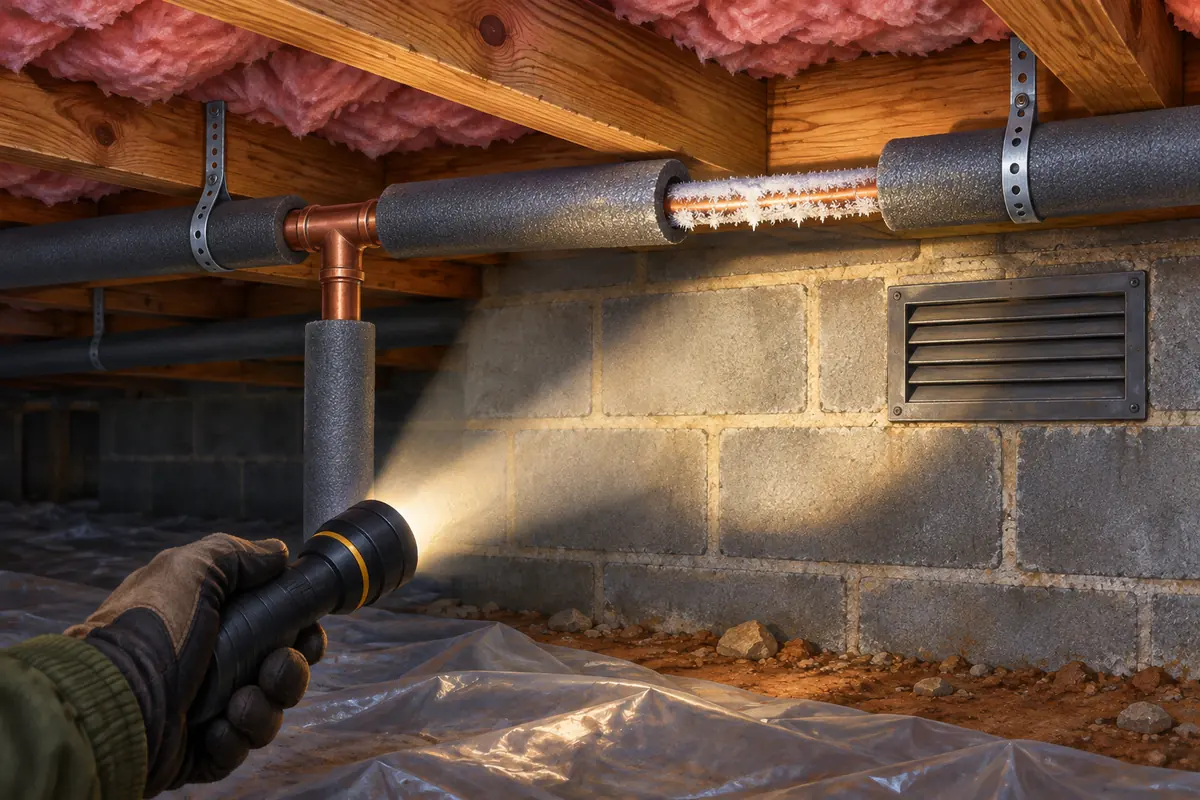
Because our houses were built for a climate that rarely drops below 20°F, and every few winters it drops below zero. Minnesota buries water lines four feet down and runs them through heated basements. Tennessee's frost line is about a foot. Most Middle and East Tennessee homes sit on vented crawlspaces with supply lines a few inches from outside air; slab homes across Georgia and West Tennessee run their water lines through unheated attics instead; and the hose bibs on a 1990s house usually aren't the frost-free kind. None of that fails at 25°F. All of it fails at 2°F.
The claims data says exactly this. In State Farm's August 2022–August 2023 book, Georgia had the highest frozen-pipe and winter water-damage payouts of any state — about $100 million — and Tennessee was third at $62 million, ahead of Texas and New York, with an average claim around $25,000. From January 2024 through June 2025 the same carrier paid more than 20,000 frozen and winter water claims totaling over $628 million, average payment above $30,000, with Tennessee again in the top five states. A separate study of 433 burst-pipe claims found the single most common place a pipe lets go is an unheated attic — the exact spot Southern slab homes put their plumbing.
| Where Tennessee and Georgia pipes freeze | Why it fails | What a claim looks like |
|---|---|---|
| Crawlspace supply lines (most Middle/East TN homes) | Open foundation vents, little or no pipe insulation, no heat | Water runs under the house unseen; subfloor, insulation, HVAC ducts soaked; mold risk |
| Attic-run water lines (slab homes, common in GA and West TN) | Attic is outside the heated envelope | Ceiling collapse into living space; the most expensive residential freeze claims |
| Pipes in exterior walls (kitchen sinks, upstairs baths) | Wall cavity gets no warm air when cabinet doors are closed | Wall, cabinet and flooring tear-out |
| Hose bibs, irrigation backflow preventers, pool equipment | Hose left attached; device sits above grade | Covered if water enters the house; the device itself often isn't |
| Water heaters and softeners in garages | Unheated garage, exterior wall | Garage slab, drywall, anything stored on the floor |
| Second homes, rentals between tenants, cabins between bookings | No one there to notice for days | The largest losses — water runs until someone drives up |
The winters that write these claims are the ones people here remember by name. Winter Storm Elliott, December 22–27, 2022, sent sub-zero air into Tennessee the day before Christmas, knocked out power to more than 306,000 customers at its peak, and pushed TVA into rolling blackouts for the first time in its history; as the thaw came, burst pipes and lost water pressure put much of the state under boil-water advisories, and eleven Tennessee counties — Davidson, Shelby, Knox and Maury among them — received a federal disaster declaration. Nationally the storm produced about $5.4 billion in insured losses. Thirteen months later, in January 2024, broken mains and household pipes dropped Memphis's water pressure far enough that more than 400,000 customers were told to boil water, and some neighborhoods had no running water for days. Georgia saw the same pattern both times. These are not freak events anymore; they are the pattern.
What exactly does the policy cover when a pipe freezes and bursts?
The resulting water damage, the tear-out to reach the break, your damaged belongings, and the cost of living elsewhere while it's fixed. On the standard HO-3 and HO-5 forms the house itself is insured against any peril not excluded, and sudden discharge of water from a plumbing system is squarely covered. Your contents are covered too — "freezing of a plumbing, heating, air conditioning or sprinkler system" is one of the named perils for personal property.
| Covered | Not covered |
|---|---|
| Drying, demolition and rebuild of walls, ceilings, floors, cabinets | The failed pipe, valve or appliance itself (the policy covers getting to it, not fixing it) |
| Tear-out of the part of the building you must open to reach the pipe | Damage from a slow or repeated leak over weeks or months |
| Furniture, rugs, electronics, clothing (actual cash value or replacement cost per your policy) | Mold and rot beyond the policy's mold limit (often $5,000–$10,000 unless you bought more) |
| Loss of use — hotel, rental, extra meals while the house is uninhabitable | Additional damage because you didn't shut the water off or dry things out promptly |
| Water that enters the house from a burst hose bib or exterior line | An irrigation backflow preventer that splits and floods the yard — no damage to covered property, no claim |
| Freeze damage to a water heater, if the loss is sudden | Wear and tear, corrosion, a pipe that was already failing |
Two line items deserve a closer look. Loss of use (Coverage D) is the one people forget to claim: if the ceiling is on the floor and the drying fans are running for a week, the carrier owes the reasonable extra cost of living somewhere else. And the mold limit is the one that ambushes slow responders — most Tennessee policies cap mold remediation at a few thousand dollars unless you've purchased a higher limit, so the clock on drying the house starts the moment the water stops.
What are the three conditions that get frozen-pipe claims denied?
Heat, occupancy, and suddenness. Nearly every denied freeze claim turns on one of them.
1. You didn't maintain heat — or drain the house. The exclusion in the standard form is written as a condition you can satisfy: freezing damage isn't covered unless you "used reasonable care to maintain heat in the building, or shut off the water supply and drain all systems and appliances of water." The standard is reasonable care, not a guarantee the pipes won't freeze. Most policies name no temperature; adjusters commonly use 55°F as the practical floor, and some carriers print a number. A thermostat set at 62 that lost the battle against a 4°F night in a vented crawlspace is reasonable care — pipes in unheated spaces can freeze at any thermostat setting. A furnace switched off to save money while the house sat empty is the textbook denial. Smart-thermostat history is the best evidence you can hand an adjuster, because it shows what you did, not what you say you did.
2. The house was vacant or unoccupied. For the dwelling itself, the heat-or-drain condition applies whether or not you're home. For your contents, and under most landlord and secondary-home forms, the condition is tied to the building being unoccupied — and many of those forms add a separate vacancy clause that narrows or removes coverage after 30 or 60 consecutive empty days. The words matter: courts have generally read "vacant" as empty of furnishings and "unoccupied" as nobody living there, so a furnished house you left for a long weekend is neither. A rental with no tenant since Thanksgiving is both.
3. The leak wasn't sudden. The policy pays for discharge that happens all at once, and excludes "constant or repeated seepage or leakage over a period of weeks, months or years." A supply line that split during the January freeze and dripped behind a wall until you noticed the floor buckling in March is the hardest version of this claim — the freeze was sudden, the damage was gradual, and the adjuster will try to separate the two. The related duty is mitigation: once you know water is loose, you have to stop it and start drying. Damage that happened because you waited is on you.
What if the power went out — like the TVA blackouts in December 2022?
You are generally still covered. The condition is about your care, and losing heat because the utility shut it off is not a lapse in your care. Across Tennessee in December 2022, people woke up on Christmas Eve to furnaces that had been dark for hours on TVA's orders. A homeowner whose heat went off on the utility's instruction did not fail to maintain it — that is simply how the condition is written — and the same logic applied to Memphis households that lost water and heat in January 2024.
Two practical points. First, document the outage — screenshot the utility's text alerts and outage map, keep any rolling-blackout notice. Second, know that homeowners forms do contain an exclusion for power failure that originates off your premises, but it carves back coverage for a covered loss that follows on the premises — which is what a burst pipe is. A few carriers' proprietary forms word this differently. If an adjuster leans on the power-failure exclusion, ask them to cite the exact paragraph, and loop in your agent.
Is a burst pipe subject to my wind/hail percentage deductible?
No, and this is the good news in the whole article. Tennessee carriers have spent five years pushing homeowners onto 1% and 2% wind/hail deductibles, which on a $500,000 house means $5,000 to $10,000 out of pocket on a hail claim. That percentage applies to wind and hail only. A frozen pipe is an "all other perils" loss and comes off your flat deductible — typically $1,000 to $2,500. If you've been staring at your renewal wondering whether that big percentage now applies to everything, it doesn't; here's how a percentage deductible actually works, and here's the wind/hail version specifically.
The one thing to check: a handful of newer policy forms add a separate water-damage deductible or a water-damage cap — sometimes $10,000 on "non-weather" water. Freezing is normally classed as weather water, but ask your agent two questions at renewal: Does my policy cap water damage, and does freezing count as weather?
Will a frozen-pipe claim raise my rate or get me non-renewed?
One freeze claim in a historic cold snap usually won't. Three water claims in four years will. Carriers code claims from a declared weather event differently from the slow-leak, failed-supply-line "non-weather water" claims that drive their worst loss ratios, and most treat a catastrophe-coded freeze claim more gently at renewal. But any paid claim sits on your CLUE report for seven years, and some carriers surcharge every one. The pattern that reliably ends in a non-renewal letter is repeat water losses on the same house.
So the honest advice is the usual advice: if the damage is within a few hundred dollars of your deductible, pay it and don't file. If a ceiling is down, file immediately — the policy requires prompt notice, and in a regional freeze the adjusters are triaged by who called first. And if your renewal arrives with a water surcharge you think is wrong, this is how to read the increase.
What about a rental, an Airbnb, or a cabin that sits empty in January?
This is where the conditions have teeth. A primary home has someone in it to hear the pipe let go. A landlord's dwelling-fire policy, a Smoky Mountain cabin with no bookings until spring break, or a lake house closed from Thanksgiving to April is unoccupied by definition — and the freeze condition on those forms is usually written to apply whenever the building is unoccupied, with a vacancy clause behind it.
- Long-term rentals. The landlord policy covers the building; the tenant's renters policy covers their belongings. If a tenant turns the heat off and leaves for two weeks, the landlord's carrier may still pay — but will look hard at whether the lease required heat to be maintained and whether anyone checked. Put a minimum-temperature clause in the lease and a smart thermostat on the wall. Between tenants, drain the house or keep heat on and document it. Dwelling-fire vs. landlord coverage, explained here.
- Short-term rentals. Gaps between bookings in January are the risk, and your platform's host program is not insurance for this — it is your own STR policy that pays. A remotely monitored thermostat and an automatic shutoff valve are the difference between a $500 plumber visit and a $40,000 claim nobody is home to catch. The Tennessee STR insurance pillar covers the policy itself.
- Cabins and lake houses. Frozen pipes are the number-one loss on both. Sevier County cabins on exposed ridgelines and lake houses that sit empty midweek are exactly what secondary-home forms are pricing for — the Smokies cabin article and the lake house article both go into the vacancy and freeze clauses in detail.
What should I do in the first hour after a pipe bursts?
- Shut off the main water valve. Know where it is now — usually at the meter near the street, in the crawlspace near where the line enters, or in a garage or utility room. Open the lowest faucet in the house to drain pressure.
- Kill power to the wet area at the breaker if water is near outlets, the panel, or electronics.
- Photograph and video everything before you touch it — standing water, the wet ceiling, the pipe, the ruined contents. Then photograph again as you clean up.
- Start drying immediately. Pull up rugs, move furniture, get air moving. You have roughly 24 to 48 hours before mold starts, and the mold limit on your policy is small. Calling a water-mitigation company is a covered expense; don't wait for the adjuster to approve it.
- Call your agent or the carrier's claim line the same day. In a regional freeze, the queue is long and the policy requires prompt notice.
- Keep the damaged items until the adjuster has seen them or released you to dispose of them. Keep every receipt — plumber, fans, hotel, meals.
- Don't thaw a pipe with an open flame. Hair dryer or heat tape, with the faucet open. Torches start house fires every winter.
- Hire carefully. Tennessee limits a contractor's down payment to one-third of the job, licenses can be checked at verify.tn.gov, and anyone knocking on your door offering to "waive your deductible" is offering something that is illegal in this state. The same storm-chaser rules from our hail-damage checklist apply here.
How do I keep it from happening — and does prevention lower my premium?
Most of it is one afternoon in November. Disconnect every hose and shut off and drain the outdoor spigots. Close crawlspace vents and slip foam sleeves over every supply line you can reach under there. Insulate attic-run lines or, better, box and heat-tape them. Know your main shutoff. When a hard freeze is forecast: thermostat no lower than 55 day and night, cabinet doors open under sinks on exterior walls, a pencil-width drip from the faucet farthest from the meter, and garage doors shut if the water heater lives out there.
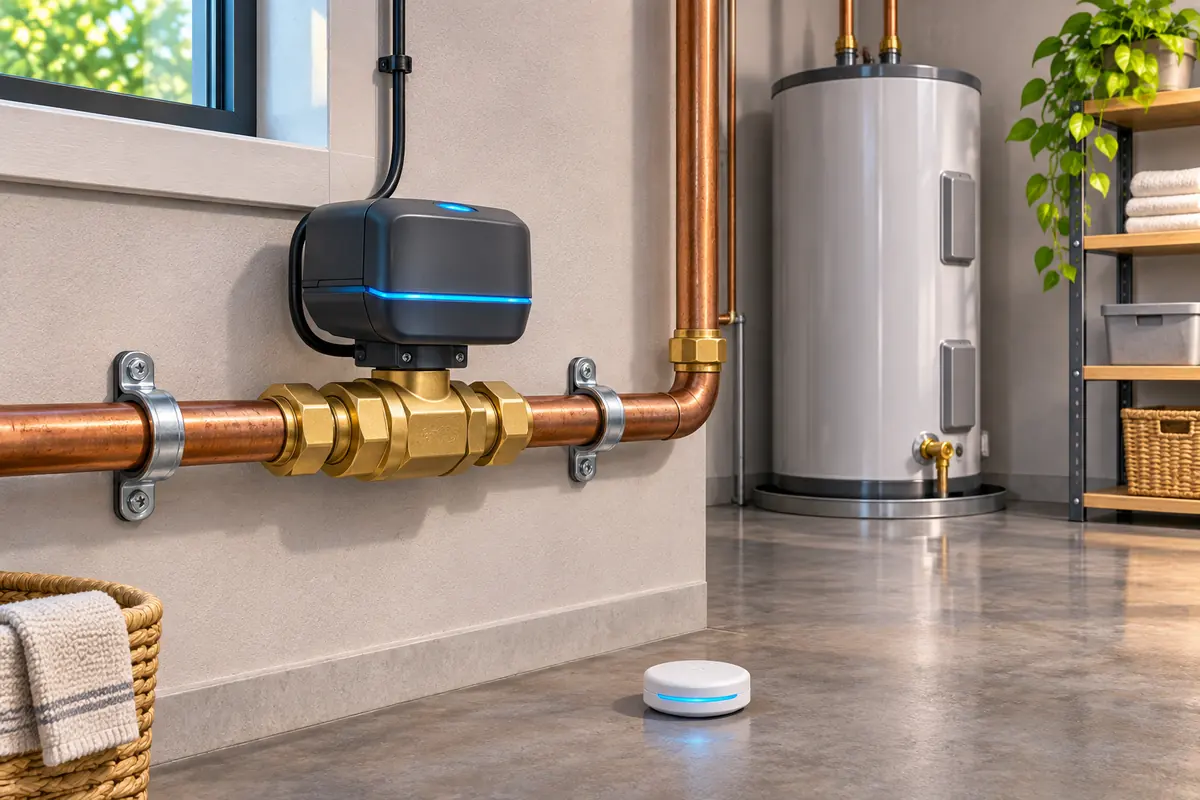
Then spend a little money on the two devices that actually change the claim: a low-temperature sensor that texts you when the crawlspace or the cabin drops toward 40°F (about $50), and an automatic water shutoff that closes the main when it detects abnormal flow (roughly $500 to $2,000 installed). Several carriers now give a discount for a monitored shutoff valve, and some high-value and secondary-home carriers are starting to require one. Even where there's no discount, a shutoff turns a week-long unnoticed leak into a puddle.
The claim is covered. The conditions are the whole game.
Frozen-pipe damage is one of the most reliably paid claims in Tennessee and Georgia — it's your regular deductible, not the percentage one, and a utility blackout isn't held against you. What turns a $30,000 covered loss into a denial is a house left cold, a building left empty past the vacancy clock, or a leak left running. Those are the questions worth asking about your policy before the first single-digit night, especially if you own a rental, a cabin, or a lake house.
Start a quote with Lumenbo and we'll match you with one licensed local independent agency — their agent can read your current policy's freezing and vacancy language against several carriers, tell you whether your form caps water damage, and find out which carriers credit a shutoff valve. More straight answers in the Learning Library.
Informational only — not a quote or a coverage determination. Policy forms vary by carrier and change; the "reasonable care," vacancy and mold provisions quoted here are typical of standard forms but your policy controls. Verify specifics with your carrier.
What is Lumenbo? Lumenbo is an insurance matching platform that connects people with one licensed local independent agency — and the software those agencies run on. Lumenbo is not an insurance carrier and not an insurance agency. Your Lumenbo-matched agent is a licensed agent at that partner agency, and they stay your point of contact.
Frequently asked
Does homeowners insurance cover frozen pipes that burst?
Yes, in almost every standard Tennessee or Georgia homeowners policy. Water damage from a pipe that freezes and splits is treated as sudden and accidental, so the policy pays to dry out and repair the house, replace ruined contents, and tear out walls or floors to reach the broken section. What it will not pay for is the pipe itself, damage from a slow leak that ran for weeks, mold beyond the policy's mold limit, or a freeze loss in a home where no reasonable effort was made to keep heat on or drain the plumbing.
What does the 'maintain heat' condition actually require?
Reasonable care, not perfection. The standard form says the freezing exclusion does not apply if you used reasonable care to maintain heat in the building, or shut off the water supply and drained the systems and appliances. Most policies name no exact temperature; adjusters commonly treat about 55°F as the floor, and a few carriers write that number into the policy. A thermostat left at 60 that could not keep a crawlspace pipe above freezing in a single-digit night is reasonable care. A furnace left off while you were in Florida for January is not.
Does insurance pay to fix the pipe itself?
Usually not, and it rarely matters. The standard homeowners form excludes the cost of repairing the pipe or appliance that failed, but covers the cost to tear out and replace the part of the building you have to open to get at it, plus all the resulting water damage. On a typical burst-pipe loss the plumber's repair is a few hundred dollars; the drywall, flooring, cabinets, drying equipment and contents are the real claim, and those are covered.
Is frozen-pipe damage subject to my wind/hail percentage deductible?
No. A burst pipe is paid under your all-other-perils deductible — the flat $1,000 to $2,500 most Tennessee homeowners carry — not the 1% or 2% wind/hail deductible that applies only to wind and hail losses. On a $500,000 house that is the difference between $1,000 out of pocket and $5,000 or more. Do check whether your form has a separate water-damage deductible or a water-damage cap; a few newer policies add one.
What if the power went out and that's why the pipes froze?
Generally still covered. The condition is that you used reasonable care to maintain heat; a utility outage you did not cause — like the rolling blackouts TVA ordered across Tennessee on December 23–24, 2022 — is not a failure of care on your part. Document the outage with the utility's alerts or outage-map screenshots and tell the adjuster up front. Policy forms differ on how they treat off-premises power failure, so if your carrier pushes back, ask them to point to the exact exclusion language.
Does a frozen-pipe claim raise my home insurance rate?
A single freeze claim during a declared cold event is usually coded as weather-related and treated more gently than a non-weather water claim, but it does go on your CLUE report for seven years and some carriers surcharge any paid claim. What reliably costs people their policy is a pattern — two or three water claims in a few years — rather than one burst pipe in a historic freeze. If the damage is close to your deductible, pay it yourself and keep the claim history clean.
What about a rental house or a cabin that sits empty in winter?
The freeze conditions get stricter. Landlord (dwelling-fire) and secondary-home policies typically apply the heat-or-drain requirement whenever the building is unoccupied, and many add a vacancy clause that narrows coverage after 30 or 60 consecutive empty days. A rental between tenants in January, a Smoky Mountain cabin with no bookings until March, or a lake house closed for the season is exactly the loss carriers are pricing for. A smart thermostat with a low-temperature alert and an automatic water shutoff are the two devices that keep those claims payable.
Ready to get matched? One licensed local agent. No shared leads, no spam.
Start your quote
This article is general information for education, not insurance advice or a quote. Coverage, availability, and rules vary by insurer and by state.