Learn / Rental & short-term rental (Tennessee)
Does Homeowners Insurance Cover Your Dock and Boathouse? Lake House Insurance in Tennessee, Explained
Updated 2026-09-01 · reviewed by a licensed agent
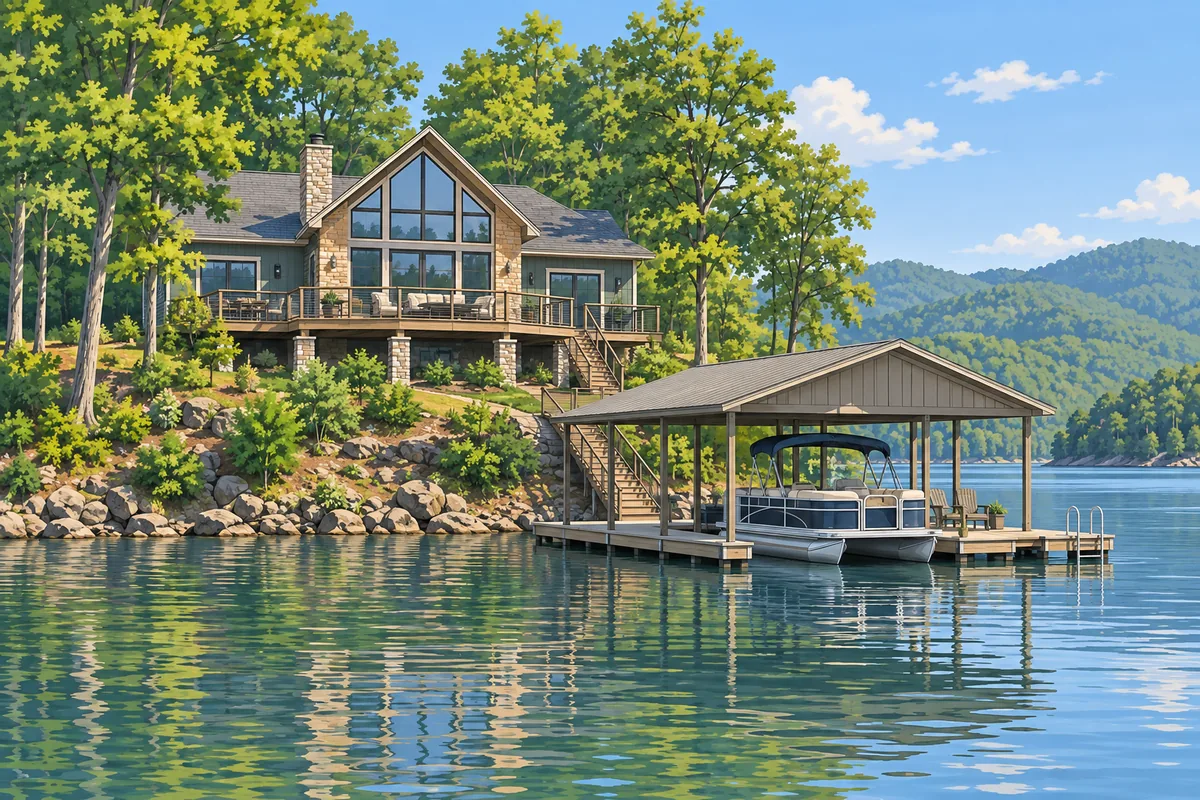
A Tennessee lake house is really three risks wearing one address: a house that sits empty most weekdays, a dock or boathouse that lives half-in, half-out of the water, and the boat and toys that make the place worth owning — and a standard homeowners policy covers the first one well, the second one partly, and the third one almost not at all. The dock is where owners get surprised. Wind tearing the roof off a covered slip is usually a paid claim; the same storm's waves pounding the flotation apart, or February ice heaving the pilings, usually isn't, and flood insurance won't pick it up either.
This is the lake version of the second-home problem. If the property is a short-term rental first and a getaway second, start with the Tennessee Airbnb and VRBO host insurance pillar; if you rent it out some weekends and use it the rest, the homeowners business-exclusion trap applies to a lake house exactly as it does to a Nashville condo.
How is a lake house insured — as a home, a second home, or a rental?
The policy has to match the occupancy, and lake houses drift between all three. A carrier will write a house you live in, a house you visit, or a house strangers rent — but on three different forms with three different sets of conditions, and the claim gets contested when the form and the reality don't agree.
| How you actually use it | The right policy | What changes |
|---|---|---|
| Primary residence on the lake | Standard homeowners (HO-3 or HO-5) | Normal terms; best rates; full personal property and liability |
| Second home you use yourself | Secondary / seasonal homeowners | Tighter vacancy and freeze conditions; often requires your primary home to be disclosed; sometimes written by the same carrier as your primary |
| Nightly or weekly rentals (Airbnb, VRBO, direct) | Short-term rental policy | Business use contemplated; guest liability; loss of rental income; a secondary homeowners policy excludes this |
| Leased for months to one tenant | Dwelling-fire / landlord policy | Tenant occupancy; your contents limited to what you furnish; loss of rents (dwelling fire vs. landlord, explained) |
The mixed case is the common one in Tennessee: the family uses it in July and rents it in October. That is a short-term rental risk with owner use, not a second home with a side hustle, and it needs to be underwritten as the former — the same call a Smoky Mountain cabin owner has to make.
Does homeowners insurance cover a boat dock?
Partly. A dock attached to the shoreline of the insured residence usually falls under Coverage B, Other Structures — but the standard homeowners form carves out exactly the perils that destroy docks. Coverage B on most policies defaults to 10% of the dwelling limit, which on a $600,000 lake house is $60,000 to share between the dock, a detached garage, a storage shed and a seawall.
Here is what the standard form says, in plain English:
| Cause of dock damage | Standard homeowners policy |
|---|---|
| Fire or lightning | Covered |
| Straight-line wind or a tornado tearing at the structure | Covered (subject to your wind/hail deductible) |
| A tree falling on it | Covered |
| Wave action, even wind-driven waves | Excluded — falls under the water exclusion (waves, spray, overflow of a body of water) |
| Rising or falling lake level, surface water | Excluded — water exclusion |
| Freezing, thawing, pressure or weight of ice or water on a pier, wharf or dock | Excluded — a specific named carve-out on the standard form, "whether driven by wind or not" |
| Collapse of the dock | Excluded unless a building or part of a building collapsed onto it |
| Gradual rot, rust, wear, animal damage | Excluded, as on any structure |
Two more wrinkles carriers apply differently. Some treat a floating or removable dock as personal property rather than a structure, which moves it to a different limit and, on many policies, a shorter list of covered perils. And some carriers require the dock to be scheduled — listed on the policy with its own value — before they'll pay a dollar on it, particularly for docks with roofs, lifts, and enclosed storage.
The practical fix is a dock and boathouse endorsement or a specifically scheduled other structure that names the water perils, and it isn't universal. Carriers that write a lot of lake property offer it; carriers that write suburban houses often don't. Ask, in those words: "Does this policy cover wave and ice damage to the dock, and is the dock scheduled?" If the answer to either is no, you know what you own.
Does flood insurance cover a dock or boathouse?
No. The National Flood Insurance Program does not cover docks, piers, boathouses over water, seawalls or retaining walls, and most private flood policies mirror that. This is the part people find backwards: the one policy built for rising water specifically excludes the structure that sits in it.
Flood coverage on the house is a separate question and a real one. Tennessee's lakes are managed reservoirs — TVA and the Corps of Engineers move levels seasonally and hold back floodwater on purpose — so lakefront homes above summer pool often sit outside the mapped high-risk zone and owners assume the topic is closed. It isn't. Heavy inflow events push managed lakes above their normal operating range, tributary creeks flash-flood regardless of what the main lake is doing, and the standard flood-insurance rules in Tennessee apply to a lake house as they do to any other: no temporary-housing coverage on NFIP, a $250,000 building cap, and a 30-day wait.
Is my boat covered by my lake house policy?
Almost not at all. A standard homeowners policy limits watercraft — hull, motor, trailer and equipment combined — to about $1,500 of personal property, on named perils only. That's the cover on a kayak, not on a pontoon.
Liability is the bigger gap. Homeowners liability covers you operating small boats — typically outboards up to 25 total horsepower, inboards or inboard/outdrives up to 50 horsepower, sailboats under 26 feet. Above those thresholds, the guest who is hurt on the tube behind your wake boat, the swimmer you didn't see, the dock you hit at the marina — none of that is your homeowners policy's problem.
Tennessee doesn't require boat insurance by law, which is why so many lake boats are uninsured or insured only because a lender required it. A separate boat policy handles the hull on an agreed-value or actual-cash-value basis, the liability (with limits that can then be stacked under an umbrella), and the things lake owners actually claim: a lower unit on a stump in the winter drawdown, a lift failure, a trailer accident on the way to the ramp. Boat lifts themselves are their own question — some carriers treat the lift as part of the dock, some as boat equipment, and a few as neither until it's scheduled.
Golf carts, side-by-sides and jet skis follow the same logic: they're vehicles, not property, and a property policy won't respond to them.
Do dock permits affect insurance?
Yes, in two ways: a carrier may ask for the permit before scheduling the dock, and an unpermitted or non-conforming structure is a live problem at the claim desk and at closing.
Tennessee's lakes are almost all federal reservoirs, and a private dock is a structure over federal land or water:
- TVA lakes — Norris, Cherokee, Douglas, Watts Bar, Fort Loudoun, Tellico, Chickamauga, Tims Ford, Kentucky Lake and the rest of the Tennessee River system — require a Section 26a permit for any dock, pier, boathouse, boat lift, seawall or shoreline stairs. In newer developments residential facilities are capped around 1,000 square feet, the application fee for a residential dock is $1,000, and TVA targets 120 days to decide.
- Corps of Engineers lakes — Percy Priest, Old Hickory, Center Hill, Dale Hollow, Cordell Hull, Cheatham — use a Shoreline Use Permit, and the Nashville District limits or bans new private docks on much of its shoreline. The permit is tied to the person, not the property: when the house sells, the new owner has a short window (currently 14 days) to apply, or the facility has to come out.
Neither permit transfers automatically with the deed, and both agencies will require an old dock brought to current standards when it changes hands. Verify the specific lake's rules with the agency before you buy or build — they differ by reservoir and change.
The insurance angle: a dock you can't legally have is a dock a carrier will struggle to pay for, and a lender will notice at closing when the permit isn't in the buyer's name. Get the permit squared away first; then schedule the dock.
What's the claim lake house owners actually file?
Frozen pipes — from the inside, not the lake. A lake house with no one in it Monday through Thursday in January is an unoccupied building. A supply line that lets go Tuesday morning runs until someone drives up Friday afternoon, and by then it's a flooring, drywall and cabinet claim, not a plumbing bill.
Most policies condition freeze coverage on either maintaining heat or shutting off and draining the water, and secondary-home forms are stricter about it than primary ones. Some add a vacancy provision that narrows coverage after a set number of consecutive unoccupied days — and a lake house closed from Thanksgiving to spring break can trip it. Read the clause before winter. A low-temperature alarm and an automatic water shutoff cost less than a single deductible.
Right behind freeze losses: wind and trees (lakefront lots are wooded lots; a tree on the roof is covered, a tree that falls without hitting anything usually isn't), lightning (the tallest thing on an open shoreline is your dock roof or your house), and theft from an empty house — which is one reason carriers ask whether a lake house has central-station alarms and how far it sits from a staffed fire station.
The affluent-household version of this problem
A lake house is rarely someone's only asset. Owners typically have a primary home, two or three vehicles, the boat, and increasingly a primary home that has crossed into high-value territory on its own. Splitting all of that across four carriers is how the gaps open: the umbrella that doesn't sit over the boat policy, the lake house that isn't scheduled under the same umbrella, the dock nobody scheduled at all.
The better structure is usually one household program — primary home, lake house, autos, boat and umbrella coordinated so the liability limits stack and the water perils on the dock are actually named somewhere. Not every carrier will write all of it; the ones that will tend to be the ones that write a lot of lake property in the first place. Note too that a percentage deductible on the lake house is a percentage of the dwelling limit, not the claim, and the roof over a covered slip is often subject to the same wind/hail deductible as the house.
Get the dock, the house and the boat underwritten as what they are
A lake house insured as a house, with a dock that's assumed to be covered and a boat that's assumed to be included, has three uninsured gaps in it. Insured as a second home or short-term rental with a scheduled dock, a real boat policy, and an umbrella over all of it, it's a very writable risk.
Start a quote with Lumenbo and we'll match you with one licensed local independent agency whose agent places Tennessee lake property — they can tell you which carriers will name wave and ice damage on the dock, whether your lake's permit situation is going to be a problem, and how to structure the boat and umbrella so the limits actually stack. More straight answers in the Learning Library.
Informational only — not a quote or a coverage determination. Policy forms, carrier appetite, and TVA / Corps of Engineers permit rules vary by lake and change; verify specifics with the carrier and the managing agency.
What is Lumenbo? Lumenbo is an insurance matching platform that connects people with one licensed local independent agency — and the software those agencies run on. Lumenbo is not an insurance carrier and not an insurance agency. Your Lumenbo-matched agent is a licensed agent at that partner agency, and they stay your point of contact.
Frequently asked
Is a boat dock covered by homeowners insurance?
Usually under Coverage B (Other Structures), which on most policies is 10% of the dwelling limit — but with specific carve-outs. Standard homeowners forms exclude damage to a pier, wharf or dock from freezing, thawing, and the pressure or weight of water or ice, whether wind-driven or not, and exclude dock collapse unless a building collapsed onto it. Fire, lightning and straight-line wind damage are generally covered. Some carriers treat a floating or removable dock as personal property rather than a structure, which changes both the limit and the perils.
Does flood insurance cover a dock or boathouse?
No. The National Flood Insurance Program does not cover docks, piers, boathouses over water, or seawalls, and most private flood policies follow the same rule. Rising water is also excluded on the homeowners policy. That leaves rising-water and wave damage to a dock largely uninsured unless a carrier offers a specific dock endorsement or a marine-type policy that names those perils.
Is my boat covered by my lake house policy?
Barely. A standard homeowners policy caps watercraft — boat, motor, trailer and equipment combined — at about $1,500 in personal property, and only for named perils. Liability for operating a boat is excluded above small motors (typically over 25 horsepower outboard or over 50 horsepower inboard/outdrive, and sailboats 26 feet and longer). A pontoon, wake boat or bass boat needs its own boat policy — for the hull, the liability, and the guest who falls off the tube.
Is a lake house insured as a second home or a rental?
It depends on how it's used, and the policy has to match. A second home you use yourself is a secondary or seasonal homeowners policy, often with tighter vacancy and freeze conditions. Rent it nightly on Airbnb or VRBO and it's a short-term rental risk that a secondary homeowners policy excludes. Lease it for months at a time and it's a dwelling-fire or landlord policy. The wrong label is the most common reason a lake house claim gets contested.
Do I need a permit for a dock on a Tennessee lake, and does it affect insurance?
Yes. On TVA reservoirs (Norris, Cherokee, Douglas, Watts Bar, Tellico, Tims Ford, Kentucky Lake and others) any structure over TVA land or water needs a Section 26a permit; on U.S. Army Corps of Engineers lakes (Percy Priest, Old Hickory, Center Hill, Dale Hollow) it's a Shoreline Use Permit, and many Corps lakes limit or ban new private docks entirely. Permits don't automatically transfer with the property. An unpermitted or non-conforming dock is a problem at the claim desk and at closing — and some carriers ask for the permit before they'll schedule the dock.
What's the most common lake house claim?
Water — from the inside, not the lake. Frozen and burst pipes in a house that sits empty midweek in January are the leading lake house loss, and most policies condition freeze coverage on keeping heat on or draining the plumbing. Wind and tree damage are next. Dock losses are frequent but small; the expensive dock losses are the ones that turn out to be excluded.
Ready to get matched? One licensed local agent. No shared leads, no spam.
Start your quote
This article is general information for education, not insurance advice or a quote. Coverage, availability, and rules vary by insurer and by state.